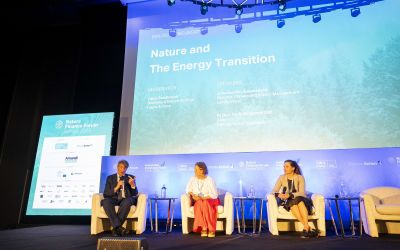
Claire Gauthier on AI and Capital Projects in Energy & Utilities
Conversation with Claire Gauthier, EVP, Global Head of Energy & Utilities. Capital Projects and AI.

How is AI changing the way capital projects are planned and delivered in the energy and utilities sector?
The energy industry is facing an unprecedented infrastructure challenge. Global energy investment exceeded $3.3 trillion in 2025, while data-center electricity demand alone is expected to exceed 940 TWh by 2030.
Against that backdrop, AI is transforming project delivery by helping organizations move from reactive project management to predictive decision-making. AI can analyze schedules, procurement data, contracts, engineering documentation, risk registers, and field reports to identify emerging risks, forecast schedule impacts, and recommend interventions before delays materialize.
The most important shift is the creation of a digital thread connecting capital allocation, engineering, procurement, construction, commissioning, and future operations.
Capital efficiency is now possible at scale thanks to AI, but without human experience and intelligence, technology won’t be sufficient!
Where do you see AI making the biggest difference across major infrastructure and capital projects today?
The greatest impact is emerging in four areas: project controls and risk management; engineering productivity; supply-chain orchestration; and executive decision-making.
AI agents can continuously monitor project performance, identify schedule risks, review technical documents, optimize equipment logistics, and support portfolio-level investment decisions.
Capital allocation is becoming increasingly complex. For example, our recent Capgemini Research Institute report found that 67% of electricity executives receive phantom data-center load requests and roughly 19% ultimately never materialize, creating major risks of over- or under-investment. AI-powered scenario modeling can help executives navigate these uncertainties.
How can AI help organisations deliver the infrastructure needed for the energy transition more efficiently and sustainably?
The energy transition is fundamentally an infrastructure challenge.
AI improves productivity by automating routine engineering and project-management activities, improves predictability through better risk forecasting, improves capital efficiency through portfolio optimization, and improves sustainability by reducing waste, rework, and excess material consumption.
This is increasingly important because 77% of electricity executives report difficulty forecasting future demand as AI-driven consumption patterns become more volatile and harder to model.
What have you learned about using AI successfully on large capital projects, and what advice would you give to other organisations?
The biggest lesson is that successful AI programs start with business outcomes rather than technology.
The strongest programs focus on schedule predictability, engineering productivity, capital efficiency, supply-chain visibility, and risk management. Strong data foundations are essential.
Industry estimates suggest AI could unlock approximately $110 billion annually in value across energy operations by 2035, yet only 16% of electricity companies have deployed advanced AI capabilities at scale today, highlighting a significant opportunity. The Challenge is on data foundations and process streamlining, without these two “legs”, in addition to governance and human intelligence, there is no AI at scale on core operations.
Looking ahead, what opportunities do you see for AI to transform capital projects and support climate action over the coming years?
We are moving toward a future of autonomous project intelligence.
AI agents will increasingly monitor project performance, coordinate workflows, recommend interventions, and continuously optimize delivery outcomes in real time. Combined with digital twins and operational technology, this will create feedback loops where lessons from operating assets improve future project delivery.
With global energy investment already above $3.3 trillion annually, even modest productivity gains can unlock billions of dollars of value and accelerate the infrastructure needed for decarbonization.
Closing Soundbite
The energy transition is no longer primarily a technology challenge; it is a delivery challenge. AI will not replace engineers or project managers, but it will give them the ability to manage unprecedented complexity, make better decisions, and deliver infrastructure faster, safer, and more sustainably. We are shifting to a world where efficient system orchestration is the competitive advantage, especially in the power sector.
Sources Referenced
IEA World Energy Investment 2025; IEA Energy and AI 2025; Capgemini Research Institute, AI Meets the Grid: Shaping the Data Center Power Play (2026).


_400_250_s_c1.png)