China’s Emissions Plateau as Renewables Rewrite the Energy Landscape
After 21 months of flat or falling emissions driven by record renewable expansion, China may be approaching a turning point, but coal dependence means the real test is whether this momentum can deliver sustained long-term decline.
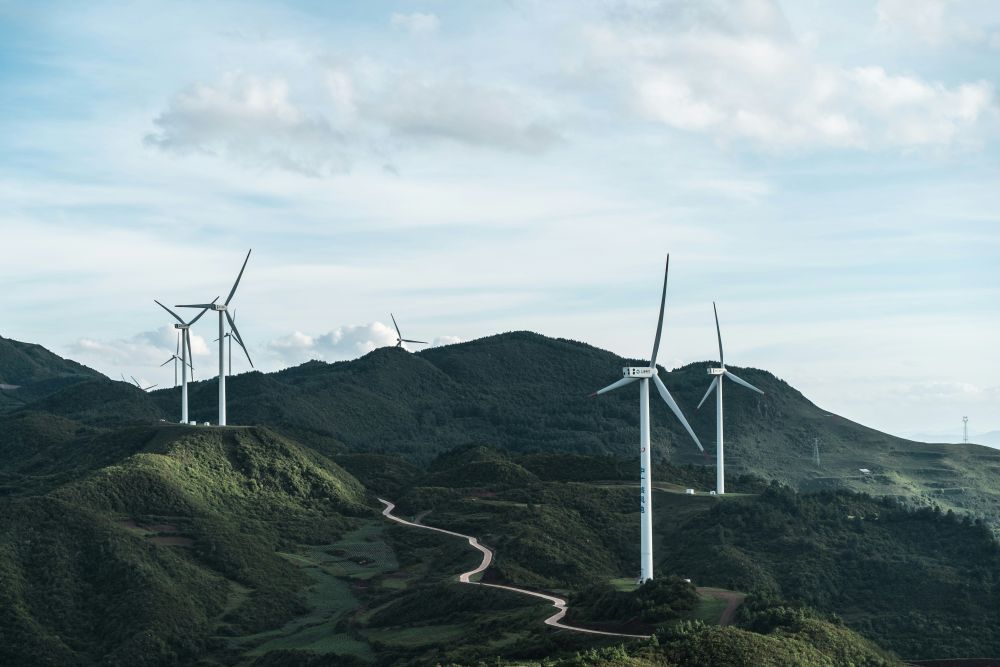
China’s carbon dioxide emissions have long stood at the centre of global climate debates. In 2026, however, the narrative may be shifting. A new analysis suggests that China’s CO2 emissions have been flat or declined for 21 consecutive months, even as electricity demand continues to grow.
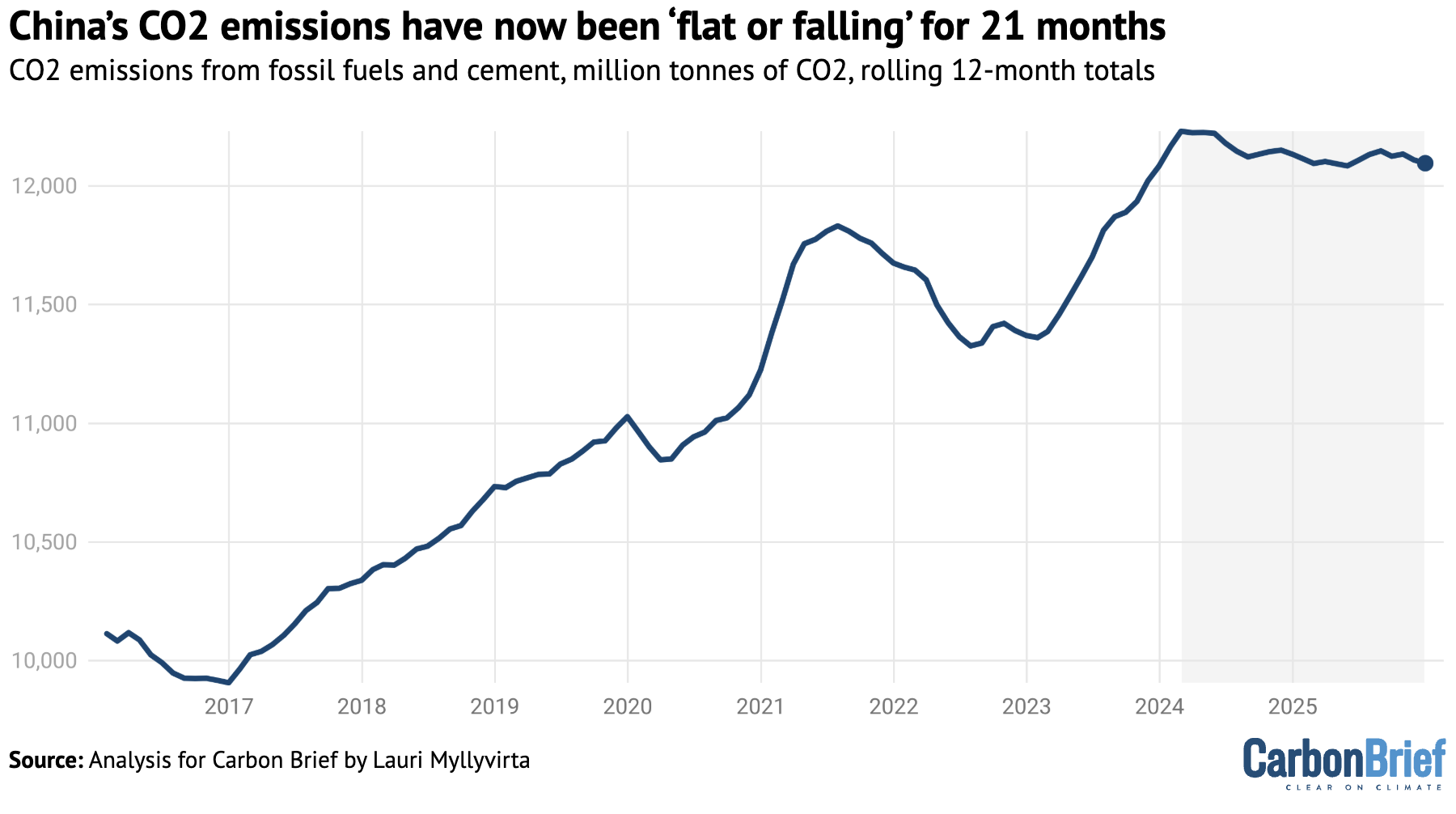
Source: Lauri Myllyvirta (2026), “China’s CO2 emissions have now been ‘flat or falling’ for 21 months,” Carbon Brief. Available at: https://www.carbonbrief.org/analysis-chinas-co2-emissions-have-now-been-flat-or-falling-for-21-months/
According to analysis from Carbon Brief, China’s emissions fell by approximately 1% year on year in the final quarter of 2025, contributing to an estimated annual decline of 0.3%. This is a significant transformation for China, which accounts for roughly one-third of global CO2 emissions, more than any other country.
The shift is being driven and sustained by China’s unparalleled clean energy expansion. Ember’s China Energy Transition Review 2025 shows that China became the world’s largest clean energy investor in 2024, spending $625 billion USD, or 31% of the global total of $2,033 billion USD. In the three years leading up to 2024, China’s wind and solar capacity more than doubled, rising from 635 GW to 1,408 GW. By early 2025, the combined capacity of wind and solar had surpassed that of coal. In the first six months of 2025, new wind and solar installations were more than twice the amount added during the same period in 2024, showing that investment is translating directly into rapid deployment.
Despite rapid progression on renewable deployment, significant challenges remain. Coal remains central to the energy system, supplying around 60% of electricity and dominating heavy industries such as steel, cement, and chemicals. While government measures including an expanded emissions trading scheme, renewable energy targets, and industrial electrification policies signal growing ambition, they remain insufficient to align emissions reductions with the Paris agreement’s 1.5 °C target.
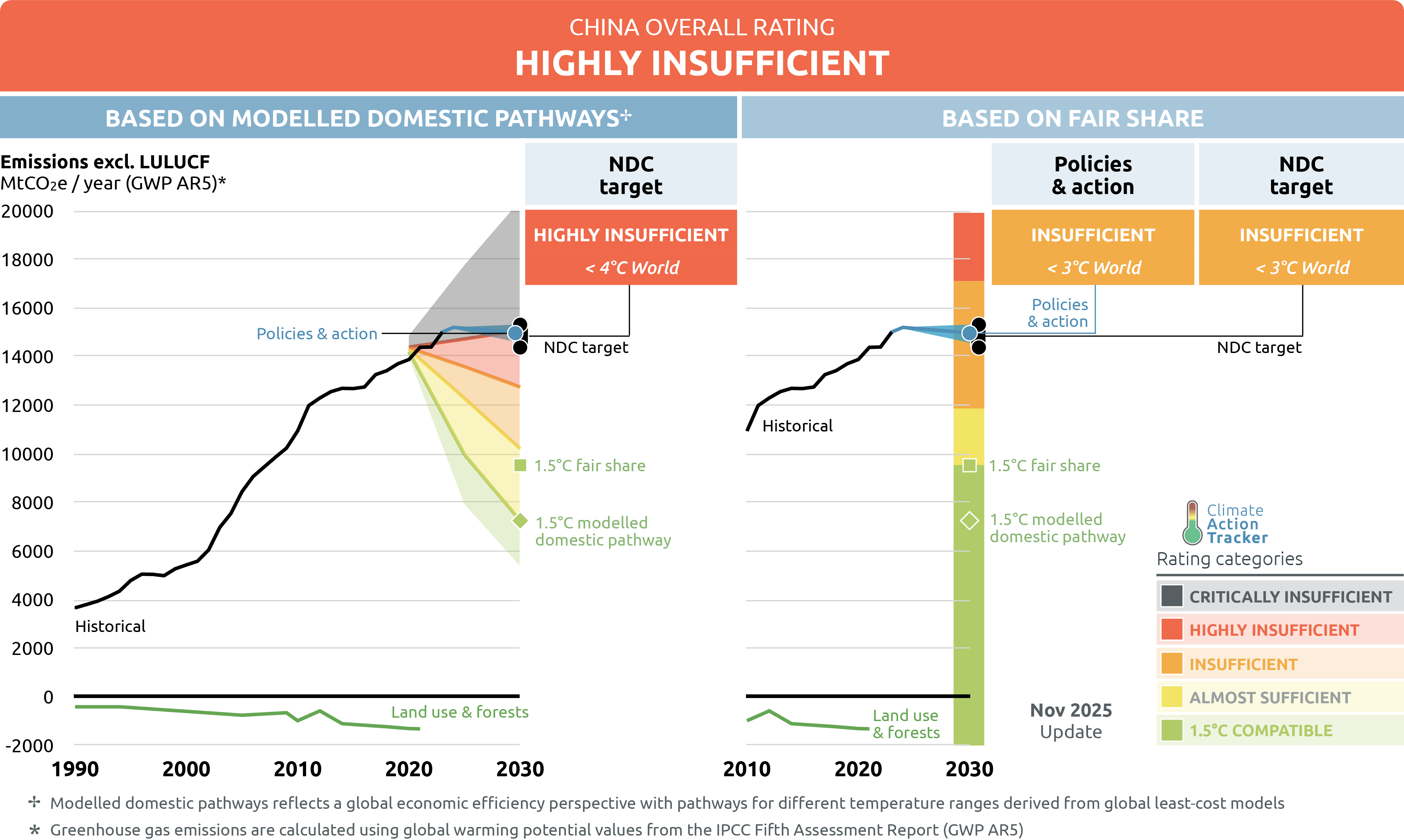
Source: Climate Action Tracker (Nov 2025 update), China country assessment. Available at: https://climateactiontracker.org/countries/china/
The key question now is whether China can turn this momentum into a sustained decline in emissions. Continued clean energy expansion, stronger policy implementation, and a gradual reduction in coal dependence will determine whether the world’s largest emitter can demonstrate that rapid decarbonisation at scale is achievable and reshape global expectations for climate progress.
This article is part of our 2026 global emissions series, tracking national progress on the journey to COP31. Each month, we will be highlighting one country and examining how its emissions trajectory is evolving. Keep an eye on climateaction.org and follow Climate Action on LinkedIn to see which country we focus on next!